
When landmarks fall, one thing remains

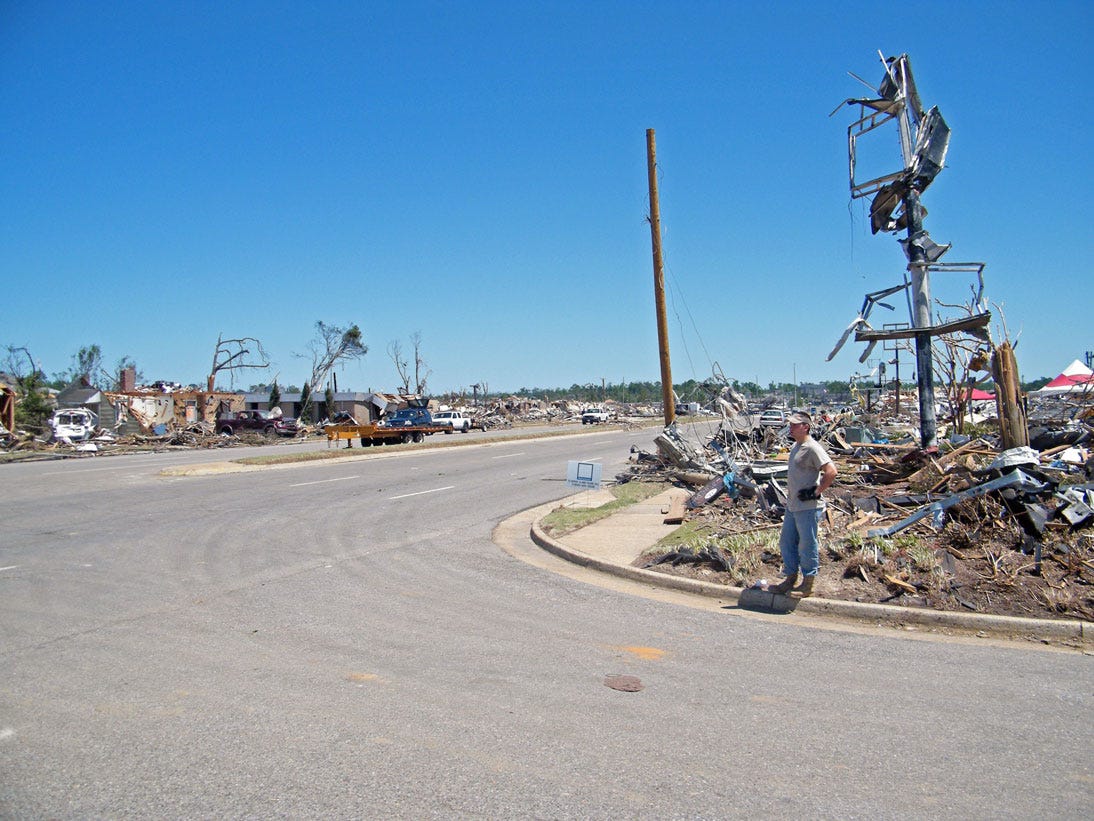
I sat staring at the image above, taken just a couple of days after the devastating Tuscaloosa tornado of April 27, 2011.
The anniversary was just three days ago as I write this. I located the photo in a desktop folder. It was one that I took on April 29 when I accompanied several men from here who jumped in a truck and drove to Tuscaloosa to help anyone they could find.
I thought I needed to write something about the tornado. I thought about how Tuscaloosa was changed in so many ways — physically, emotionally, economically. I could have written about the initial response to the tornado’s impact; how people came together to make a difference. I could have written about the chaos a natural disaster brings. All of those things would have been good stuff for a Substack.
But I just kept staring at the photo. We were actually in a staff retreat for my church Monday. It just stayed on my laptop most of the morning.
The photo is of the intersection of McFarland Boulevard and 15th Street. Until April 27, 2011, it was one of the most recognizable intersections in Tuscaloosa. There was a mall on one side and an iconic Krispy Kreme on the other. No matter which direction you were traveling, you could use it for navigation. You knew how close (or far) you were from Druid City Hospital, or Skyland Boulevard, or University Boulevard.
On that day, unless you were told, you would have no idea you were standing at McFarland and 15th.
Instead of sitting down to write about the tornado, I began to think about a number of people close to me who are experiencing catastrophic circumstances in their lives due to health matters or other concerns.
It is in moments like those that you can lose your bearings. Things that you had often used as landmarks in your life can be ripped up and laid bare. What do you do when so many things that you knew to be solid in your life were quickly leveled?
Karl Marx said religion is the opium of the people. He saw religion as providing a pleasant illusion that numbs current suffering, or at least dulls it. He believed religion served to keep normal people oppressed. If they knew their condition, he thought, the people would rise up to change their condition.
Psychologist Sigmund Freud said God is an illusion created in the mind to meet deep psychological needs. Although he didn’t coin the phrase, he saw religion as a “crutch” to deal with the unpleasant aspects of living.
Made-up, illusionary aspects of dealing with life are common. They are also temporary. They only carry you so far. People deal with unpleasant aspects of life in all sorts of ways. Alcohol and drugs are two well-known ways to numb. Many people turn to food, or they work all day, every day. They may bury themselves inside their phone through social media or games and apps.
Those always come to poor ends. If Marx and Freud were correct, society would have come to the same conclusion about faith. Overwhelmingly, it has not.
There is a reason that a real crutch serves you better when you have a broken leg than an imaginary one. When you put those very real objects under your armpits, you have full confidence it will take you where you need to go. Those very real crutches make contact with a very real floor or ground to move you in a very real direction.
Try to pick up a pair of imaginary crutches and move anywhere. Your face will meet that very real floor. That’s why rock bottoms exist for alcohol and drug abuse.
It may come in a matter of days, or even years. It will come, however.
Christianity has reigned supreme for 2,000 years because of its reality. If Christianity was a man-made illusion, it would have collapsed on itself long ago. There is a there, there.
As society has become more weird, more crazy, more dark, there are more people realizing the substance of what Christianity is. There is sin. Humans can’t fix it, no matter how hard we try. There is a solution that can only be found in Jesus Christ.
The people within my circle who are facing these catastrophic circumstances don’t have an illusory landmark. They have a very real point of navigation. They have a true North that makes it possible to move forward when it would be impossible otherwise.
It’s why so many thinkers and influencers have explored everything else, but keep coming back to Jesus after everything comes up short.
It’s why former Sen. Ben Sasse — with days or just months left to live — can face his final days on earth with steadfastness.
If it’s so easy, then why isn’t everyone a Christian?
It’s not easy. It requires a very hard thing for a human to do.
Surrender.
But in that surrender, there is freedom. There is a true North.
When everything else is laid flat, it will always stand. It always has.
Pursue Christ in surrender.